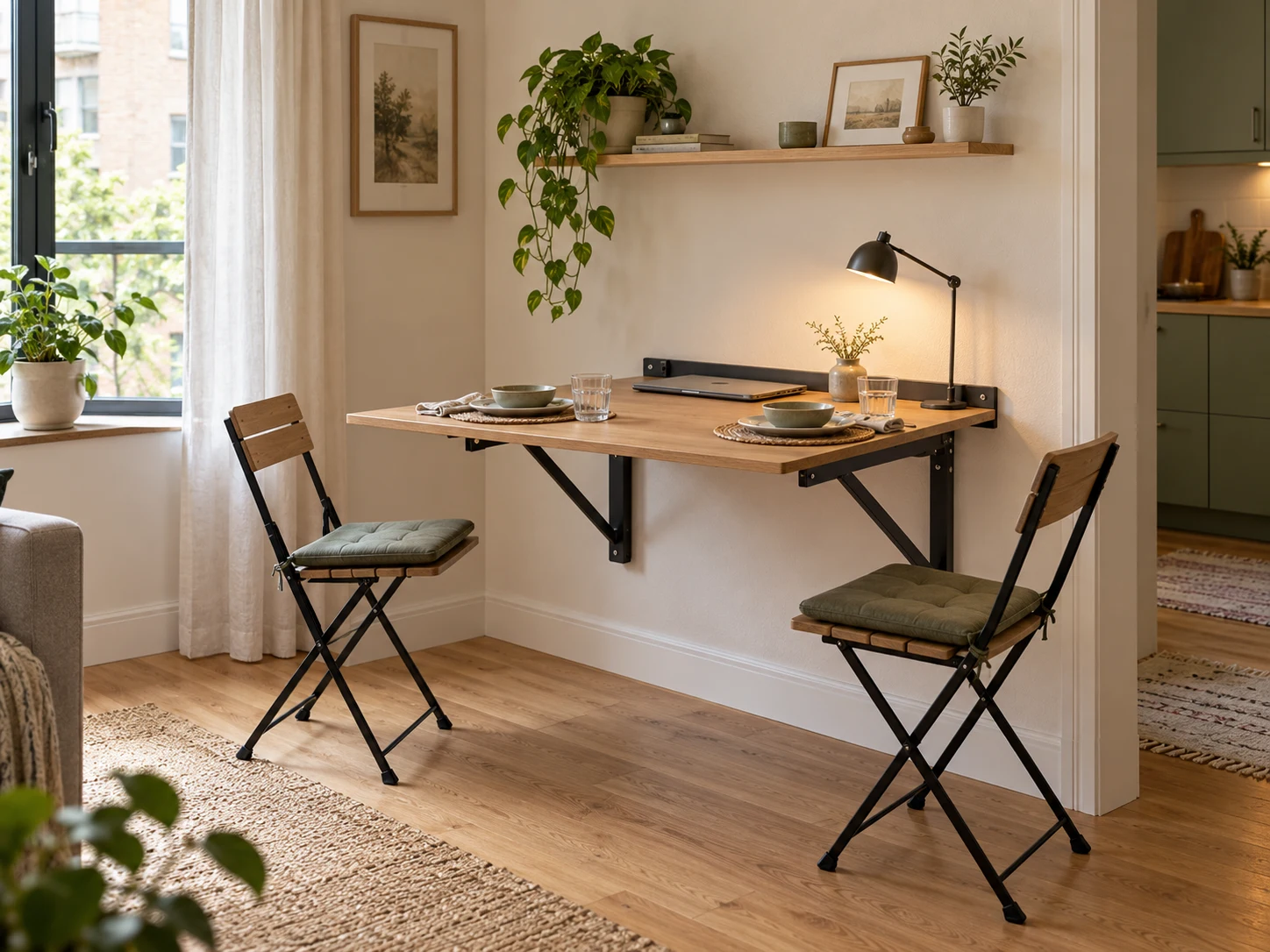
The best fold-down table is not simply the one with the smallest folded profile. It is the one that opens to a useful surface, stays stable during the real task, leaves room for bodies and chairs, and can be reset without turning every meal or work session into a furniture project.
For a renter or anyone unsure about the wall, a freestanding drop-leaf, gateleg, or portable folding table is usually the safer starting point. A wall-mounted table can reclaim more floor area, but only when the exact wall construction, fasteners, bracket spacing, installation height, and product instructions are known. Never assume drywall alone can carry a table because a listing describes the brackets as “heavy duty.”
This is an editorial buying framework, not a hands-on product test or a structural assessment. AptNook checked the linked manufacturer information on October 26, 2026. Dimensions, availability, specifications, and instructions can change, so verify the exact model before buying or drilling.
Quick picks by everyday use
| Everyday need | Best starting type | Why it works | Main compromise |
|---|---|---|---|
| One-person laptop work or breakfast | Compact wall-mounted drop-leaf table | Clears the floor when closed and can sit at a chosen height | Requires a suitable wall and careful installation |
| Daily meals for two | Deeper wall-mounted table or small freestanding drop-leaf table | Provides enough depth for opposing place settings | Chairs still need storage and pullback room |
| Flexible meals for two to four | Freestanding drop-leaf or gateleg table | Expands without transferring the working load to a wall | Keeps a permanent folded footprint |
| Occasional projects or extra guests | Portable table with folding legs | No wall alteration and easy to relocate | Must be carried and stored somewhere |
| Kitchen prep, laundry, or workshop tasks | Purpose-rated wall worktable | Can provide a larger, tougher surface | Load, moisture, heat, and mounting requirements are task-specific |
If one table must support both work and meals, choose for the more demanding activity. A surface that barely fits a laptop may fail as soon as a plate, glass, serving dish, or notebook needs to share it.
1. Choose the mechanism before the finish
“Fold-down table” can describe several different systems. They do not solve the same problem.
Wall-mounted drop-leaf
The top pivots from a wall-mounted rail or cabinet and is supported by folding brackets, hinged arms, a leg, or a frame. This type produces the smallest closed footprint, but the wall and installation become part of the furniture system. Check whether the top folds up or down, what remains exposed when closed, and whether the support hardware intrudes into knee space.
Freestanding drop-leaf or gateleg
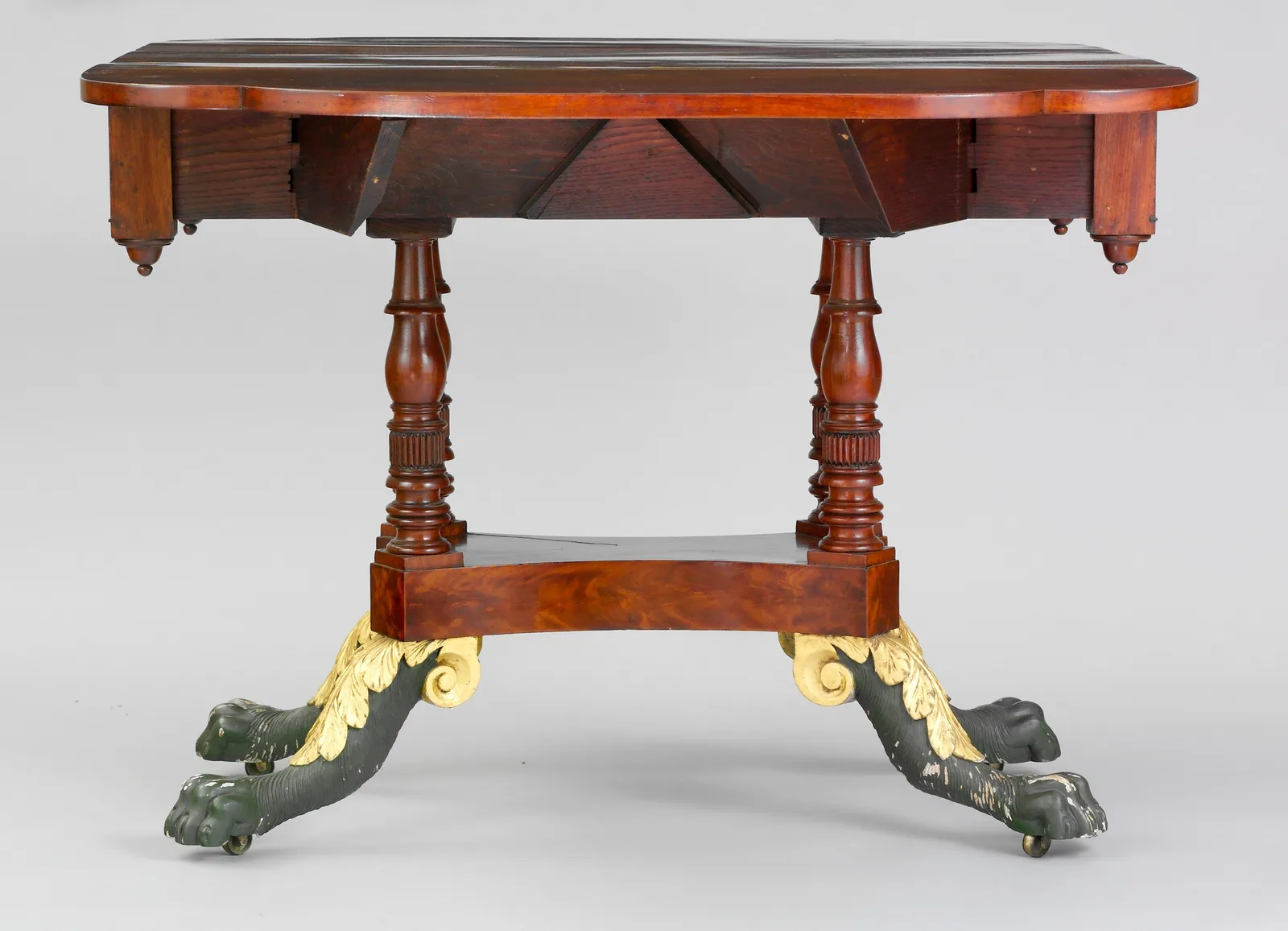
One or two leaves hinge from a fixed center or side section. Swing-out legs or gates support the open leaf. This is often the best everyday compromise for renters: no structural wall attachment, a familiar dining height, and easier relocation. The center section and feet remain in the room when folded, so measure that permanent footprint.
Portable folding-leg table
The top remains one piece while the legs fold beneath it. It can disappear into a closet or stand against a wall, but every use requires lifting, unfolding, locking, and later storing the whole table. It works best when the storage route is short and the user can handle the product safely.
Cabinet, mirror, or convertible wall table
These designs conceal the surface behind storage, artwork, or a mirror. They can look resolved when closed, but they are more complex, often deeper, and may require professional installation. Confirm the full open depth and do not let the attractive closed view hide the operating footprint.
2. Measure the open room, not only the folded table
Record three states on the floor and wall: closed, opening, and fully in use. Product pages often lead with the closed profile, yet the open state determines whether the table supports daily life.
Measure:
- the full tabletop width and depth;
- the distance from the wall to the furthest open edge;
- any arc needed by a leaf, leg, gate, or bracket;
- chair depth when occupied and when pulled back;
- the route between the table, doorway, kitchen, and storage;
- nearby drawers, cabinet doors, radiators, outlets, and window coverings; and
- the folded projection at hip, shoulder, or head height.
Use painter's tape for the top and place the actual chairs in position. Sit down, stand up, carry a plate around the occupied chair, open adjacent doors, and operate the table. If someone must move a chair every time another person passes, the layout is not finished.
For a broader room plan, use AptNook's tiny-apartment dining-area guide before choosing the table.
3. Size the surface for the real task
There is no universal minimum that makes every fold-down table comfortable. Plates, laptops, monitors, craft tools, mobility needs, and seating orientation change the required depth.
Make a paper or cardboard mock-up using the published tabletop dimensions. Put the real objects on it:
- for meals: plates, glasses, cutlery, serving items, and anything normally kept in the center;
- for work: laptop or monitor, keyboard, pointing device, notebook, task light, and charging cable;
- for crafts: cutting mat, tools, material feed, and a protected area for wet or hot items; and
- for mixed use: the storage tray or nearby shelf needed to reset from one activity to the next.
A narrow top can work well when two people sit side by side facing the room, yet feel crowded when they face each other. A wall-mounted surface may also lose usable depth to a rear rail, shelf, or cable gap. Judge the clear work area, not the headline dimensions alone.
4. Treat the wall and fasteners as part of the product
Before ordering a wall-mounted model, identify the wall construction and read the complete installation instructions. Confirm the required fasteners, mounting-hole pattern, bracket spacing, installation height, and whether the manufacturer requires studs, masonry, blocking, or professional installation. Keep pipes, wiring, tile, and other concealed services in the decision.
Do not transfer a load claim from a bracket to a completed table. Capacity depends on the top, hinges, brackets, fasteners, wall material, spacing, installation quality, and how the load is applied. Leaning on the outer edge creates a different demand from placing a laptop near the wall.
If the wall is unknown, damaged, hollow in unexpected places, or part of a rental where drilling is restricted, pause. A freestanding design may be the better product even if its folded footprint is larger. AptNook's rental-upgrade permission guide explains how to document and request building changes.
5. Check the lock, support, and closing sequence
Open and close the exact model if a showroom or clear demonstration is available. Otherwise, study the manual rather than inferring the mechanism from lifestyle photographs.
Look for:
- a positive lock or support that is obvious when fully engaged;
- support arms or legs that cannot be accidentally kicked free during normal use;
- controlled movement without exposed pinch points in the user's hand path;
- a clear sequence for releasing the lock and lowering the top;
- hardware that can be inspected and tightened; and
- a closed position that cannot drop unexpectedly.
Keep fingers away from hinges and supports, and keep children clear while the table changes state. Do not place hot cookware, heavy appliances, or climbing loads on a surface unless the current manufacturer documentation permits that use.
6. Plan where the chairs and tabletop items go
A fold-down table only clears space if its supporting objects also have a reset location. Decide where chairs, laptop equipment, placemats, cables, and task lighting go before choosing the mechanism.
Folding chairs can hang or store in a shallow closet, but verify their folded thickness and weight. Stackable chairs need a stack footprint. Everyday dining chairs may remain in the route even after the table closes. If the table includes storage, confirm that the contents stay accessible in both positions and that they do not make the unit too heavy or awkward to mount.
For a work-and-storage alternative that does not depend on the wall, compare AptNook's console desk versus storage vanity guide.
7. Compare documented examples without treating them as universal winners
The following examples show how different specifications change the decision. They are not rankings, endorsements, or hands-on tests.
| Documented example | Published configuration | What the specification reveals |
|---|---|---|
| IKEA NORBERG wall-mount drop-leaf table with storage | Top 25 1/4 × 23 5/8 in.; depth 5 7/8 in. closed and 23 5/8 in. open; height 29 1/2 in. | A compact two-person claim still needs a tabletop mock-up; storage remains part of the mounted load |
| IKEA NORDVIKEN drop-leaf table | 29 1/8 in. minimum length, 41 in. maximum length, 29 1/8 in. width, 29 1/2 in. height | A freestanding leaf adds capacity without wall attachment but keeps a permanent base footprint |
| IKEA GUNDE folding table | 26 3/8 × 26 3/8 in.; height 28 3/4 in.; folding legs with hooks used to lock the open position | Portable storage avoids drilling, but the whole table must be moved and the leg lock must be engaged |
See the current manufacturer pages for the NORBERG wall-mounted table, NORDVIKEN drop-leaf table, and GUNDE folding table. Recheck the exact product number, measurements, materials, locking method, care instructions, and assembly documents at purchase time.
8. Use a pass/fail buying check
Pass a candidate only if every statement below is true:
- The open tabletop holds the real meal, work, or project setup.
- The opening motion clears doors, storage, trim, outlets, and furniture.
- Occupied chairs do not remove the essential circulation route.
- The closed table and stored chairs have defined positions.
- The wall and installation method are known, or the table is freestanding.
- The exact support and lock are understandable and easy to inspect.
- The surface finish suits cleaning, moisture, heat, and abrasion for the intended task.
- Everyone who needs to reset the room can safely operate the table.
If the table passes only when the room is perfectly empty, it is not an everyday solution. If mounting remains uncertain, remove wall-mounted models from the shortlist instead of improvising anchors after purchase.
The AptNook verdict
Choose a compact wall-mounted drop-leaf table when the wall is suitable, the task is light and well defined, and recovering clear floor area matters most. Choose a freestanding drop-leaf or gateleg table when everyday dining stability, rental flexibility, and easier relocation matter more than the smallest closed profile. Choose a portable folding-leg table when the surface is occasional and there is a short, realistic storage route.
The best option is the one whose open state works—not the one that looks smallest when closed. Measure the table, chairs, people, opening motion, and reset routine as one system. If the room needs a larger expandable dining surface rather than a disappearing one, continue with AptNook's extendable dining-table guide.

David
Head of Editorial — AptNook
David oversees AptNook's editorial workflow, coordinating research, writing, and quality reviews to help readers make informed decisions about space-saving furniture and small-room solutions.